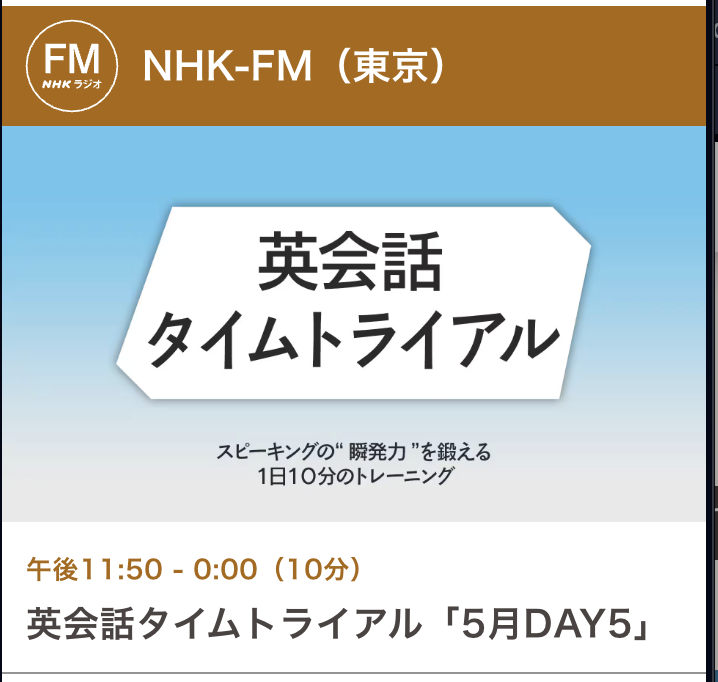
英会話 time trial 26/5/8(金)D5 復習テスト
語彙クイズ(10問)
What does “pronunciation” mean?
a) grammar
b) spelling
c) the way words are spoken
d) translation
What does “direct translation” mean?
a) free interpretation
b) word-for-word translation
c) difficult sentence
d) casual expression
What does “go out of your way” mean?
a) to ignore someone
b) to make a special effort
c) to leave home
d) to study abroad
What is the meaning of “random”?
a) organized
b) difficult
c) without a clear pattern
d) useful
Which word means “helpful”?
a) useful
b) random
c) direct
d) difficult
What does “just kidding” mean?
a) speaking seriously
b) asking a question
c) joking
d) teaching someone
What does “practice together” mean?
a) study alone
b) learn with someone
c) stop learning
d) teach a class
What does “advice” mean?
a) money
b) suggestion or guidance
c) translation
d) pronunciation
Which word means “easy to understand”?
a) difficult
b) random
c) simple
d) direct
What does “do your best” mean?
a) give up
b) try as hard as possible
c) study alone
d) ask for help
TOEIC形式問題(5問)
What phrase does the speaker introduce first?
a) Daijobu
b) Gambari-masho
c) Arigato
d) Wazawaza
What does “itsumo arigato gozaimasu” imply?
a) Thank you for today only
b) Thank you for always helping me
c) Goodbye and good luck
d) Nice to meet you
Why does Jenny think English is difficult?
a) Grammar is impossible
b) Pronunciation is too easy
c) English spelling is inconsistent
d) English has no rules
What does “daijobu” mean?
a) Good morning
b) I’m sorry
c) I’m okay / That’s okay
d) Thank you very much
What is the main topic of the conversation?
a) Business communication
b) Language learning and useful phrases
c) Japanese history
d) Travel planning
読解問題(英語)
Why does the speaker say “itsumo arigato gozaimasu” is difficult to translate directly?
What example does Jenny use to explain why English spelling is hard?
How do the speakers encourage each other at the end of the conversation?
解答.語彙クイズ
c
b
b
c
a
c
b
b
c
b
TOEIC形式問題
c
b
c
c
b
読解問題
Because it carries cultural nuances like appreciation for ongoing help or support, not just a simple “thank you.”
She compares “fun” (F-U-N) and “phone” (P-H-O-N-E).
They encourage each other by saying they will keep practicing together and do their best.
投稿者プロフィール

-
英語の文字起こしをしています。間違い等がありましたら、教えてください!
最近古文書の勉強もしています。英語も日本語も難しいですね。
最新の投稿
 テレビ会話が続くリアル旅英語2026年9月29日会話が続く!リアル旅英語 26/9/29(火)L71動物の散歩
- 基礎英語22026年9月29日基礎英語2 26/9/29(火)森林浴に行こう2
- ラジオ英会話2026年9月29日ラジオ英会話 26/9/29(火)L122 発言パターン 指示②-助動詞類などを使った指示
- テレビ会話が続くリアル旅英語2026年9月28日会話が続く!リアル旅英語 26/9/28(月)L70 体重測定
コメント